
Hyper-personalized marketing for e-commerce: know every buyer to the core
Segments are not people. How e-commerce brands build a full picture of each buyer and use it to win first orders, repeat purchases and revenue on every channel.

Most e-commerce brands say they personalize. In practice that means a first name in the subject line and a few segments: new customers, repeat customers, cart abandoners. Hyper-personalization is different. It means knowing each buyer well enough to send them the one message most likely to make them buy, on the channel they actually read, at the moment they are ready.
This post covers what that takes: the data you need on every buyer, how to turn it into decisions, the plays that move revenue at each stage of the customer lifecycle, and how AI makes it possible without a team of ten building flows by hand.
Segments are not people
A segment like "bought in the last 90 days" puts a first-time buyer of a ₹499 accessory in the same bucket as a loyal customer who has spent ₹40,000 with you over three years. They get the same email, the same discount and the same send time. One of them ignores it. The other wonders why you are offering 10% off something they would have bought anyway.
Segmentation was the best we could do when every journey had to be designed by a person. Hyper-personalization starts from the other end: one profile per buyer, rich enough that the next message can be decided for that person rather than for the average of a few thousand.
- 190M+
- customer profiles managed on Contlo
- $500M
- revenue generated for e-commerce brands
- >20%
- of revenue attributed to Contlo
- 5.8B+
- messages sent
What knowing a buyer to the core looks like
A useful buyer profile answers five questions. If your stack can answer all five for any customer in a few seconds, you can personalize properly. If it cannot, that is the gap to close first.
- Who are they? One identity across email, phone, WhatsApp, the web and the app, so a shopper who browses on mobile and buys on desktop is one person, not three.
- What have they done? Every product view, search, add to cart, checkout started, order, return and review, in order, with timestamps.
- What are they worth? Lifetime spend, order count, average order value, recency and frequency, and where available a predicted lifetime value and churn risk.
- What do they prefer? Categories, sizes, price bands, brands within your catalog, discount sensitivity, and the channel and time of day they respond to.
- What have they told you? Quiz answers, survey responses, post-purchase ratings and support conversations. This zero-party data is the most honest signal you have, and most brands never connect it to their marketing.
From profile to decision
A rich profile is only valuable if it changes what you send. For every buyer, at every moment, there are four decisions to make:
- What to say. Which products to show, whether to lead with newness, social proof, a restock or a bundle, and whether an offer is needed at all.
- Where to say it. WhatsApp for the buyer who replies within minutes, email for the one who opens every newsletter, push for the app user, SMS when the message is urgent.
- When to say it. The hour this person usually opens, and the point in their buying cycle when a nudge helps rather than annoys.
- Whether to say anything. Sometimes the most personal message is none. Suppressing a promotion for someone who just bought, or who has a complaint open, protects revenue and the relationship.
Done by hand, this is impossible beyond a handful of flows. That is why personalization has stalled at first-name merge tags for most brands, and why AI changes the economics.
Hyper-personalized plays across the lifecycle
Personalization pays off when it is tied to a revenue moment. These are the plays we see work best for e-commerce brands, grouped by where the buyer is.
Turn visitors into first-time buyers
- Preference-led welcome. A short quiz or spin-the-wheel form that asks what they shop for, then a welcome series built around their answer instead of your bestsellers.
- Browse recovery with context. Not "you left something behind" but the exact products they viewed, alternatives in their size and price band, and reviews from buyers like them.
- Cart recovery on the right channel. WhatsApp first for buyers who chat, email for those who do not, with an offer only when their history says they need one.
Turn first orders into second orders
- Post-purchase that sells the next item. Care tips and order updates, followed by complementary products pulled from the catalog at send time. One home decor brand on Contlo doubled average order value with dynamic recommendations like these.
- Replenishment on each buyer's own clock. If someone reorders every 34 days, remind them on day 30, not on a fixed 45-day schedule built for the average customer.
- Ask, then act on the answer. A post-delivery rating that routes unhappy buyers to support and asks happy ones for a review at the moment they are most likely to leave one.
Turn customers into repeat buyers
- RFM-aware offers. Champions get early access, not discounts. At-risk buyers get a reason to come back. Lapsed buyers get the product line they used to love.
- Win-back before churn, not after. Act on falling engagement and stretched gaps between orders while the buyer is still reachable.
- VIP treatment that feels personal. New arrivals in their favourite category, sizes held back, a WhatsApp message from the brand rather than a blast.
“The brands that grow repeat revenue fastest are not the ones sending the most messages. They are the ones whose every message looks like it was written for one person.”
Why AI is what finally makes this work
The idea of one-to-one marketing is decades old. What stopped it was labour: someone had to design every branch, write every variant and pick every segment. Large language models and agents remove that bottleneck.
On Contlo, Brand AI learns your brand voice, catalog and customer personas, then writes copy and creatives grounded in them. Generative journeys build a path per buyer from their profile instead of forcing everyone through the same flowchart. AI agents plan campaigns, choose segments and channels by predicted response, and draft the work for you to approve. Predictive lifetime value and churn scores, now in beta, add a forward-looking view of each buyer to the profile.
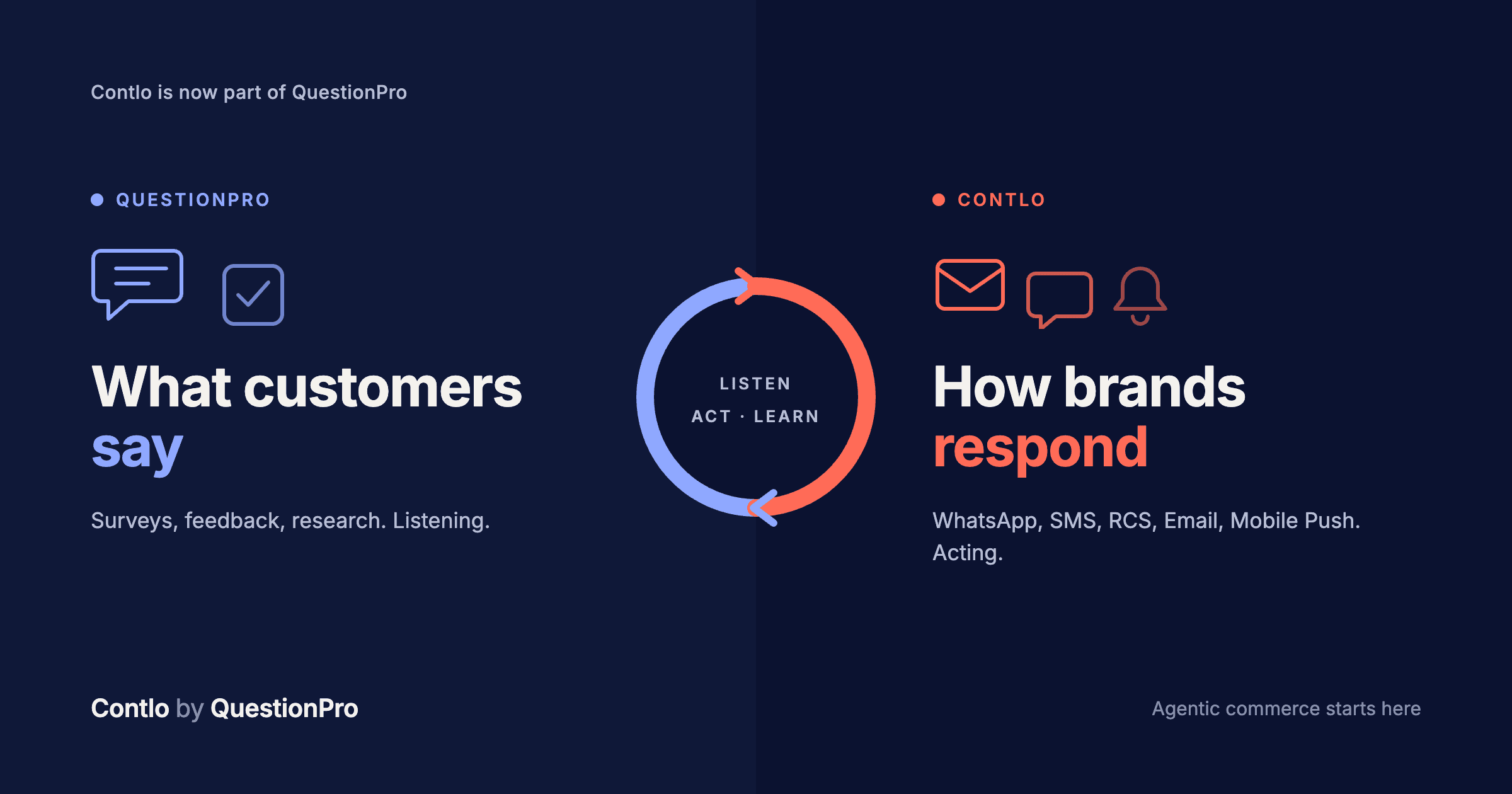
Because Contlo is now part of QuestionPro, the fifth question, what buyers have told you, is becoming a native part of the profile too. Survey and feedback answers will feed segments and journeys directly, so a buyer who says they are shopping for a gift gets gift guides, and one who rated their delivery poorly hears from support before they hear from marketing.
Measure it in revenue, not opens
Personalization is easy to overrate on vanity metrics. Higher open rates are nice. The question is whether it made more people buy, and buy again. Track these instead:
- Revenue per message sent, by channel and by journey, against a holdout group that did not receive it.
- First-order conversion rate of new subscribers and visitors.
- Repeat purchase rate and the time between first and second order.
- Share of revenue attributed to owned channels, versus what you spend on paid acquisition to get the same orders.
- Discount spend per order, which should fall as you stop giving offers to buyers who did not need them.
Personal, not creepy
Knowing a buyer to the core comes with a responsibility. Use data the buyer would expect you to use: what they browsed and bought on your store, what they told you, how they like to be contacted. Respect consent on every channel, honour opt-outs instantly, cap how often anyone hears from you, and never surface something sensitive just because you can infer it. The test is simple: would the buyer feel helped or watched?
Where to start this week
- Unify identity. Connect your store, site tracking, forms and helpdesk so each buyer has one profile.
- Pick one revenue moment. Cart recovery or the second order is usually the fastest win.
- Personalize the content, not just the name. Dynamic products, size and price-band awareness, and offers only where history says they are needed.
- Let the channel follow the buyer. Route each message to where that person responds.
- Hold out and measure. Keep a control group and judge the play on revenue per message.
- Add one zero-party signal. A preference quiz or a post-purchase question, wired straight into the journey.
Contlo connects to Shopify, WooCommerce, Magento and BigCommerce and gives you the buyer profile, the AI and the channels in one place. See how brands like Shades of Spring and Flexnest grew repeat revenue, or book a call and we will show you what Contlo would send your buyers.


Put your e-commerce marketing on autopilot
Free forever plan. No credit card. Connect your store and your Brand AI starts working toward revenue and retention goals right away.